
Best Top 5 Acupressure Points for Shoulder Pain: Benefits & How to Use Them
Shoulder pain rarely stay in the shoulder. It creep into the neck, tightens the upper back, and make sleeping on one side impossible. Acupressure is one of the oldest and simplest way to work with that tension — no equipment, no medicine, just steady pressure on specific points. Here are five acupressure points for shoulder pain that therapist use most often, what each one is actually for, and how to press them safely.
In this article
- What acupressure is and how it may help shoulder pain
- Top 5 acupressure points for shoulder pain
- How to apply pressure correctly
- Acupressure for neck and shoulder pain, stiffness and muscle tension
- Acupressure for frozen shoulder
- How often to use acupressure for shoulder pain
- When to see a doctor
- Acupressure therapy for shoulder pain in Noida Extension
- FAQs
What Is Acupressure and How May It Help Shoulder Pain?
Acupressure is a hands-on therapy from traditional Chinese medicine. Instead of needles, the therapist use fingers, thumbs or palms to apply firm, pressure to specific points along the body's energy channels, called meridians. In traditional terms, pain is understood as Energy Blockage and blood that have stopped moving freely through a channel — and pressure on the right point helps restore that flow.
In modern terms, researchers studying acupressure suggest a few overlapping mechanism may be at work: sustained pressure on a tight band of muscle can help it release, local circulation increases around the area being worked, and pressure stimulation appears to influence how pain signals are processed. The evidence base for Muscle & Joint Problem pain is promising but still limited, and results vary considerably from person to person.
What people most commonly report after acupressure for shoulder pain:
- Reduced muscle tension across the trapezius and upper back
- Easier, less guarded movement when lifting or rotating the arm
- Relief from the dull ache that builds up after long desk hours
- Better sleep, particularly when neck tightness was disturbing it
- A non-medicated option to use alongside physiotherapy or exercise
Acupressure is best understood as a supportive therapy for shoulder pain relief — something that may reduce discomfort and tension while the underlying cause is being addressed, not a replacement for diagnosis or treatment.
Top 5 Acupressure Points for Shoulder Pain
These five pressure points for shoulder pain are chosen for different reasons. Some sit directly on the shoulder muscles, others sit far away on the hand or forearm but are traditionally used to influence the shoulder and neck. Point selection should match your specific condition — not every point suits every kind of shoulder pain, which is why a therapist assesses first.
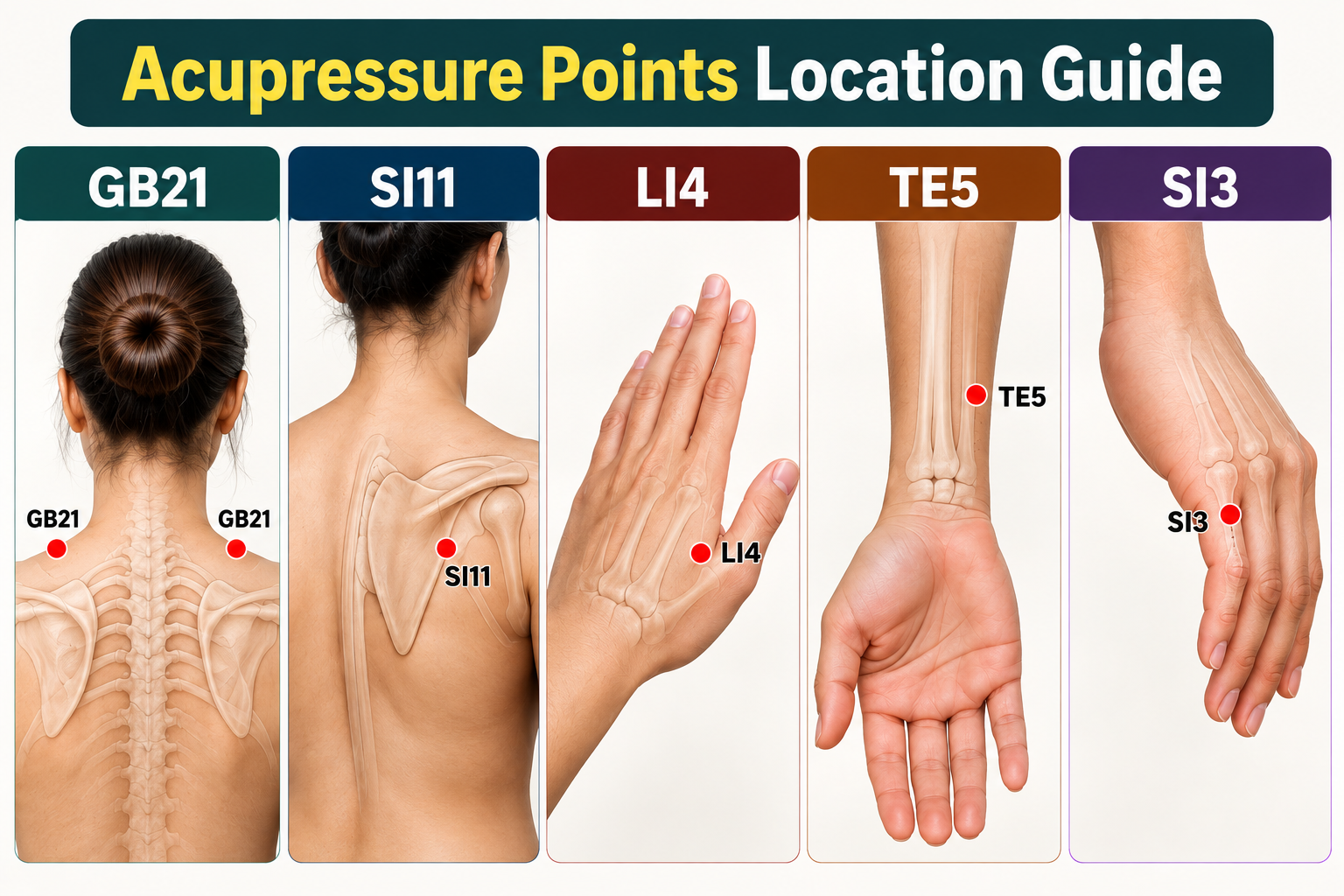
1. GB21 (Jianjing) — Acupressure Point for Shoulder Tension
- Where it is
- On the highest point of the shoulder muscle, midway between the base of the neck and the tip of the shoulder. If you drop your opposite hand over your shoulder, it lands almost exactly on this point.
- Traditionally used for
- Heaviness across the tops of the shoulders, stiff neck, tension headaches, and the tightness that builds from hunching over a laptop or phone.
- How to press
- Hook your fingers over the muscle and squeeze downward for 6 seconds, release, and repeat 3 times. Do this twice a day. This point is often tender, so use only as much pressure as you can comfortably tolerate.
- Important
- GB21 is traditionally avoided during pregnancy.
2. SI11 (Tianzong) — Acupressure Point for Shoulder Blade Pain
- Where it is
- In the centre of the shoulder blade, in the soft hollow below the bony ridge. Most people find it by pressing around until they hit one spot that feels distinctly deeper and more tender than the rest.
- Traditionally used for
- Deep, aching shoulder blade pain, pain when reaching across the body, and restricted rotation of the arm.
- How to press
- Hard to reach yourself — use a massage ball against a wall, or ask someone to apply thumb pressure for 6 seconds, release, and repeat 3 times, twice a day. Keep the pressure within what you can comfortably tolerate. A referred sensation down the arm is normal here.
3. LI4 (Hegu) — Acupressure Point for General Pain Relief
- Where it is
- In the webbing between the thumb and index finger, at the highest mound of muscle when thumb and finger are pressed together.
- Traditionally used for
- One of the most widely used points in acupressure — traditionally applied for pain anywhere in the upper body, including shoulder, neck and head pain.
- How to press
- Pinch the webbing with the thumb and index finger of the opposite hand, pressing toward the index finger bone. Hold 6 seconds, release, and repeat 3 times on each hand, twice a day. Press only as firmly as you can comfortably tolerate.
- Important
- LI4 is traditionally avoided during pregnancy.
4. TE5 (Waiguan) — Acupressure Point for Arm and Shoulder Movement
- Where it is
- On the outer forearm, about three finger-widths above the wrist crease, in the groove between the two forearm bones.
- Traditionally used for
- Pain that travels along the outside of the arm and into the shoulder, and stiffness when lifting the arm sideways or overhead.
- How to press
- Press with your thumb for 6 seconds, release, and repeat 3 times on each arm, twice a day. Slowly raising and lowering the arm while holding the point often helps. Keep the pressure comfortable, never forced.
5. SI3 (Houxi) — Acupressure Point for Neck and Shoulder Stiffness
- Where it is
- On the outer edge of the hand, just below the little-finger knuckle. Make a loose fist and it sits at the end of the crease that forms.
- Traditionally used for
- Neck stiffness that limits turning the head, upper-back tightness, and shoulder pain linked to the cervical spine.
- How to press
- Press with the opposite thumb for 6 seconds, release, and repeat 3 times on each hand, twice a day. Gently turning your head side to side while holding the point often helps. Use a pressure you can comfortably tolerate.
How to Apply Pressure on Acupressure Points for Shoulder Pain
Technique matter more than force. Pressing harder does not speed anything up, and it often leave the muscle more guarded than before.
- Sit comfortably and let the shoulder relax. Working a point while the muscle is braced achieve very little.
- Find the tender spot. Press around the described location until you find the place that feel dull, deep or achy — not sharp.
- Apply pressure gradually. Build up over a few second using the pad of your thumb or finger, not the nail.
- Use only as much pressure as you can comfortably tolerate. Firm and noticeable — roughly 4 to 6 out of 10 — never so painful that you tense up or hold your breath.
- Hold for 6 seconds, then release. Keep breathing evenly throughout; do not hold your breath while pressing.
- Repeat 3 times on each point, pausing a few seconds between repetitions, then do the same on the other side.
- Do this twice a day. Drink water afterwards and avoid heavy lifting for the next hour.
Stop immediately if you feel sharp pain, numbness, tingling down the arm, dizziness or nausea. Never press over broken skin, a fresh bruise, a swollen joint, a recent injury or any area that has had surgery.
Acupressure for Neck and Shoulder Pain, Stiffness and Muscle Tension
Neck and shoulder pain usually arrive together, because the same muscle group spans both. The trapezius runs from the base of the skull across the shoulders and down the upper back, so tightness anywhere along it is felt in several places at once. This is the most common pattern seen in desk workers, drivers, students and anyone who spends hours looking down at a phone.
For this pattern, acupressure for shoulder stiffness typically combines a local point with a distal one — GB21 to release the trapezius directly, and SI3 or TE5 to work on the same channel from a distance. LI15, at the front hollow of the shoulder joint when the arm is raised, is often added when the pain sits in the joint itself rather than in the muscle.
Acupressure works best here as part of a wider habit change. Raising your screen to eye level, taking a two-minute break every half hour, and doing simple shoulder rolls will do more for chronic shoulder muscle tension than any single session of pressure work.
Acupressure for Frozen Shoulder: Can It Help?
Frozen shoulder — adhesive capsulitis — is different from ordinary shoulder muscle pain. The joint capsule itself thickens and tightens, movement becomes progressively limited in every direction, and the condition typically moves through painful, stiff and recovery stages over many months.
Acupressure for frozen shoulder may help with the pain and the secondary muscle guarding that develops around a stiff joint, and many people find it makes their physiotherapy exercises more tolerable. What it cannot do is release the capsule itself. Restoring range of movement in frozen shoulder requires sustained, graded exercise, and often medical management alongside it.
If your shoulder is progressively losing movement rather than simply aching, get it properly assessed before starting any self-treatment. Frozen shoulder is frequently confused with rotator cuff problems, and the two are managed very differently.
How Often Should You Use Acupressure for Shoulder Pain?
For self-care at home, work two or three points twice a day — 6 seconds of pressure, repeated 3 times on each point. Morning and evening suits most people, since evening is when the day's tension has already built up. Consistency matters far more than the length of each hold.
If you are seeing a therapist, professional sessions are usually scheduled once or twice a week initially, then spaced out as symptoms settle. A rough guide for what to expect:
- Recent tension from posture or overuse: often eases within 2–4 sessions
- Long-standing neck and shoulder pain: typically needs 6–10 sessions with home practice in between
- Frozen shoulder or post-injury stiffness: a longer course, alongside medical care and exercise
These are general patterns, not promises. If four to six weeks of consistent treatment produce no meaningful change, that itself is useful information — it usually means the cause needs a different approach.
When Should You See a Doctor for Shoulder Pain?
Acupressure is not appropriate for every shoulder problem, and some shoulder pain is a sign of something that needs urgent attention.
- Left shoulder, jaw or arm pain with chest tightness, breathlessness or sweating — this can indicate a cardiac event and needs emergency care
- Shoulder pain immediately after a fall, accident or visible deformity of the joint
- Inability to lift or move the arm at all
- Numbness, tingling or weakness travelling down the arm or into the hand
- Fever, redness, warmth or swelling around the joint
- Pain that wakes you every night, or that has been steadily worsening for weeks
Acupressure should also be avoided or medically cleared first if you are pregnant, have a bleeding disorder or take blood thinners, have a joint replacement or metal implant in the area, or are being treated for cancer, osteoporosis or an active infection.
Acupressure Therapy for Shoulder Pain in Noida Extension
Self-applied pressure has real limits. You cannot reach your own shoulder blade properly, you cannot assess whether the pain originates in the shoulder joint or the neck, and choosing points without that assessment is guesswork. A trained therapist works out where the problem actually sits before deciding which points to use.
At VacuCare Wellness Center, acupressure therapy for shoulder pain in Noida Extension starts with an assessment of your posture, movement range and the pattern of your pain. Treatment is then built around your specific presentation, and often combined with cupping therapy or other modalities where the muscle tension is deep-set. We also give you two or three points to work on at home between sessions, because the daily practice usually matters as much as the session itself.
Our acupressure center in Noida Extension is at Amrapali Leisure Valley Market, Techzone 4, Greater Noida West — convenient for Gaur City, Crossing Republik and the surrounding sectors.
Book an assessment for your shoulder pain
Talk to a certified acupressure therapist in Noida Extension about what is causing your pain and whether acupressure is right for it.
Frequently Asked Questions About Acupressure for Shoulder Pain
Does acupressure relieve shoulder pain immediately?
Some people feel looser within minutes, particularly when the pain is muscular tension rather than joint damage. For long-standing shoulder pain, change is usually gradual over several sessions rather than immediate.
How many acupressure sessions are needed for shoulder pain?
Recent, posture-related pain often responds within 2–4 sessions. Chronic neck and shoulder pain generally needs 6–10 sessions with home practice in between. Your therapist should reassess after a few sessions rather than committing you to a long package upfront.
Are there any side effects of acupressure?
Acupressure is generally well tolerated. Mild soreness at the pressed points, temporary tiredness or a brief increase in symptoms for a day are the most commonly reported effects. Sharp pain, numbness or dizziness during treatment is not normal and means the session should stop.
Is acupressure safe during pregnancy?
Several points, including LI4 and GB21, are traditionally avoided during pregnancy. Acupressure during pregnancy should only be done by a therapist experienced in prenatal work, and after checking with your doctor.
What is the difference between acupressure and acupuncture for shoulder pain?
Both work with the same points and the same traditional framework. Acupuncture uses fine needles inserted into the point; acupressure uses finger and thumb pressure on the surface. Acupressure is needle-free and can be practised at home, while acupuncture reaches deeper and is often chosen for stubborn or long-standing pain.
Can I do acupressure at home instead of visiting a therapist?
Home acupressure is useful for maintenance and for everyday tension. It does not replace an assessment — without knowing whether your pain comes from the shoulder joint, the rotator cuff or the neck, you may be working the wrong points entirely.
How much does acupressure therapy cost in Noida Extension?
Cost depends on session length and whether acupressure is combined with other therapies. Contact VacuCare Wellness Center for current session pricing and package details.